EVO TEAMS: TEAMS IN EVOLUTION


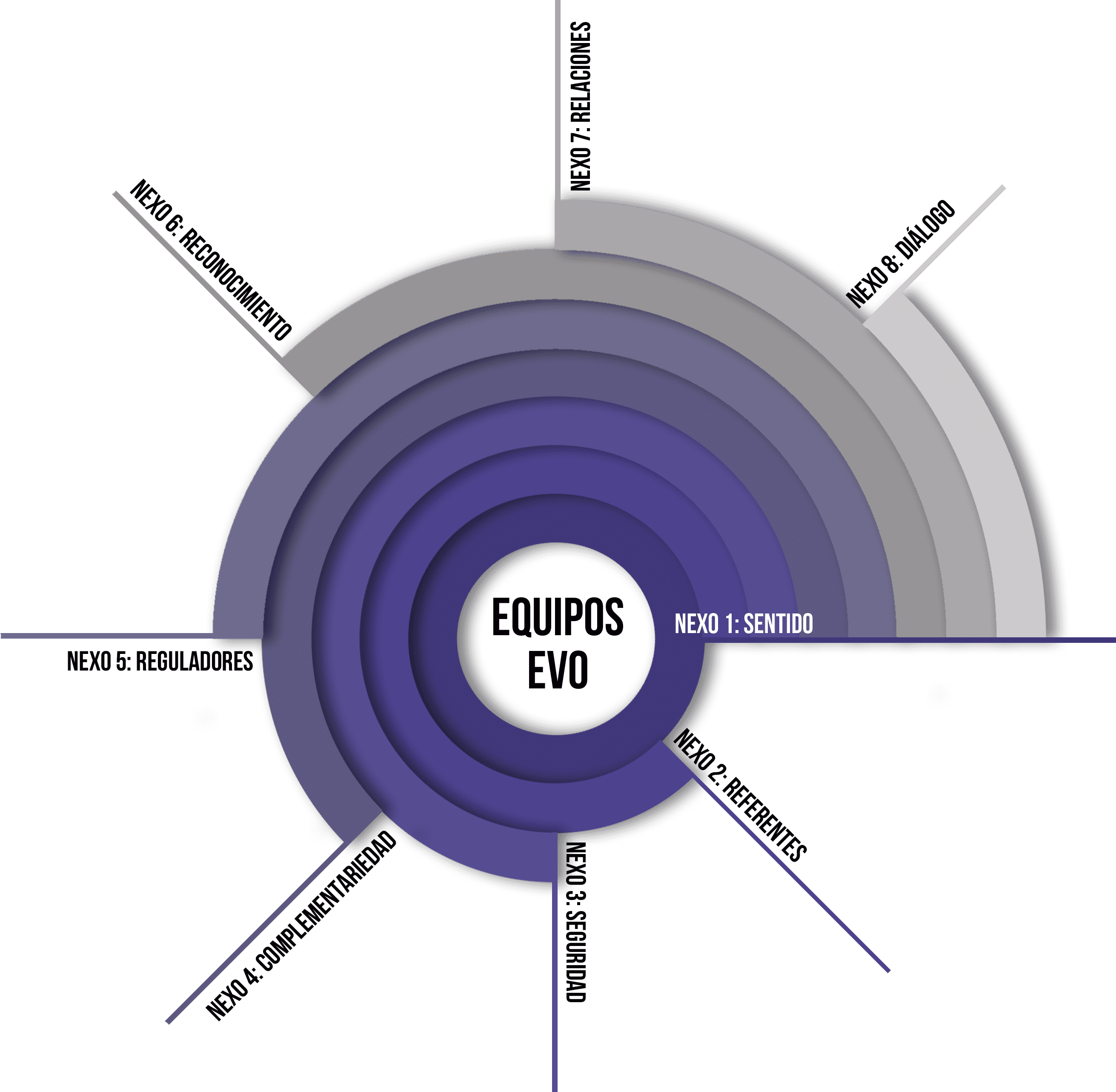
Cooperation makes us evolve as a species. Faced with uncertainty, hierarchical structures based on vertical direction are too slow, bureaucratic, and have limited visions to respond to the complex demands presented to us, where knowledge and the variability of expertise are necessary. Obedience and the "I comply and lie" approach no longer work; it is not profitable for knowledge and decisions to rest on a few. It is necessary to give a voice to those who truly make things happen. The evolution we need across all sectors is very similar. In Industry, Services, Healthcare, Education, and Administration, it is no longer enough for one person to think and the others to obey; nor is it enough for everyone to do their own thing and ignore what is happening around them. Today, it is necessary to move from the 'I' to the 'we'. We need to generate teams in EVO-lution that consider:
PURPOSE
Answering the 'why' of what we are doing. Purpose must be generated jointly among all team members; it must be understood, known, and shared so that it becomes the axis and guide for decisions for action.
ROLE MODELS (REFERENTES)
EVO Leadership pursues influence. For a leader to be one, they must be recognized by their team and accepted as a ROLE MODEL (REFERENTE); someone who cares about them, provides them with security, and knows their unique qualities; someone who knows how to support each person according to their needs.
SAFETY
Safety is an emotional state that creates a space of trust for joint construction, allowing each team member to be themselves from their singularity, where they can act without fear, and where error and discrepancy will be treated as an evolutionary opportunity.
COMPLEMENTARITY
Diversity is a fundamental principle of life: no two human beings are alike. When two or more people meet, the variety of interpretations, knowledge, opinions, and ways of doing things appears in its multiple expressions. Each person has a particular potential, and we cannot expect the same from all of them; therefore, we must help each one develop their strengths and efficiently manage their weaknesses.
REGULATORS
To achieve this, the team needs to address and establish ways of working, agreeing on the following regulators: Defining what is individual (propio) and what is common, delimiting what belongs to each member and what belongs to the entire team; individual and collective responsibilities. Defining and managing internal organizational procedures that must be known, understood, assumed, and learned by the people who will use them. Generating boundaries, answering the questions: What rules and limits do we need to apply to our functioning as a team to reach what we have defined as our objective? and How are we going to take care of each other so that we can work enjoying the process and reaching the desired place?
RECOGNITION
People want to be valued and respected for the work they do. Recognition directly affects motivation and productivity, becoming the main factor for fueling the commitment of the team members. The lack of recognition leads to a progressive feeling of invisibility.
RELATIONSHIPS
Most of the problems generated within a team are relational. The truth is that relationships between humans have never been easy to balance. In the case of teams, since they are human systems, all conditions exist for the relationships among their members to be a permanent axis of attention and concern. People treat others according to how they feel they are treated. Relational Quality, that is, the type of relationship that team members have, reflects the level of health of the internal relationships and has repercussions on the management of procedures and results.
DIALOGUE
Today, collective intelligence is needed. Innovation, development, and productivity require knowing how to maintain the necessary dialogues, knowing how to elicit and listen to different opinions to then converge on the best decisions and action plans. Communication is the essential element for collaboration and for moving toward the stated goals; therefore, the life of the team must be built upon dialogue between people who mutually recognize each other.
*These contents are part of Equipos EVO: Equipos en evolución para gestionar la complejidad e incertidumbre, written by Joan Quintana and Jesus Mari Iturrioz. The manual is available in bookstores in physical and digital format. EVO Teams is also a line of work of the Center for Relational Quality (Centro de Calidad Relacional).
DOWNLOAD PART 1 OF EQUIPOS EVO
By JOAN QUINTANA.

Comments